


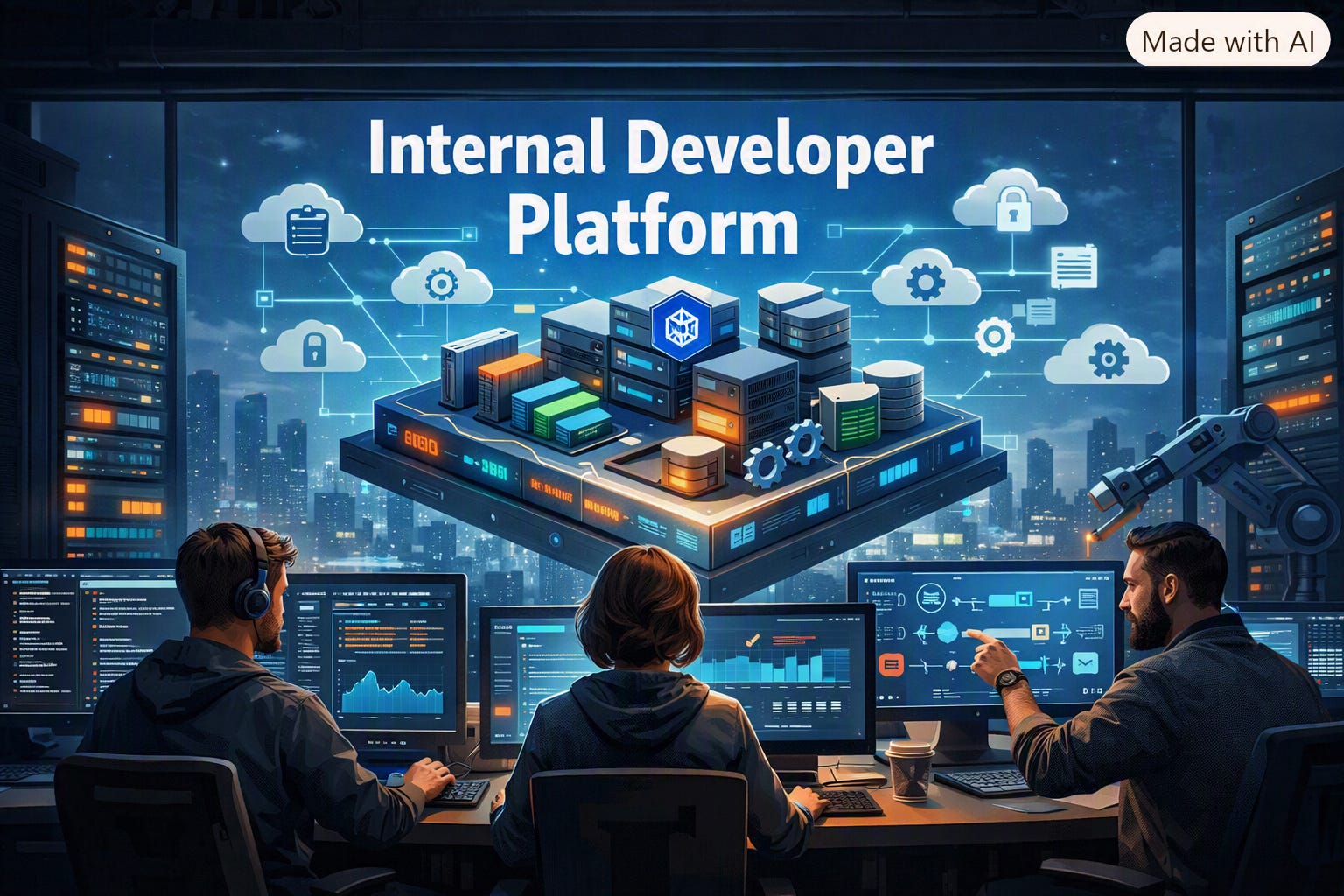
Platform Engineering: The Missing Piece for CTOs
Most Internal Developer Platforms don’t fail in production.
They fail long before anyone writes a line of code — at the whiteboard, in the moment everyone agrees to build a platform but nobody shares the same mental model of what that platform actually is.
The CTO approves the initiative. A platform team is formed. Jira fills up.
And then reality hits: every person imagines a different platform.
The tooling trap
By month two, most platform teams discover the same thing:
Deployment abstraction tools exist.
Developer portals exist.
CI/CD, security scanning, secrets management, observability — all solved problems.
But none of these tools talk to each other out of the box.
So teams spend 12 months building glue code.
Integrating Backstage with ArgoCD.
Teaching SonarQube how to behave in pipelines.
Figuring out secrets flow.
Updating documentation that expires every three weeks.
By the time the first team uses the platform, the platform engineers are exhausted and the requirements have drifted.
This isn’t a tooling problem.
It’s a product problem.
What a platform actually is
A platform treated like an integration project works for the team who built it.
A platform treated like a product works for every team that comes after.
A real platform has:
a defined customer (development teams)
a clear value (ship software without touching Kubernetes internals)
a lifecycle (versioned, maintained, improved)
Most IDPs have none of this.
The missing piece nobody ships
Almost every IDP misses the same gap:
The entire path from “code written” to “code in production,” automated and consistent.
That means:
CI pipelines with uniform security gates
Secrets provisioned automatically and rotated without manual work
Grafana dashboards created the moment a service is deployed
A full commit‑to‑production path generated from one configuration file
This is not a dream.
It’s an engineering problem — and solvable.
Why this matters for CTOs
The number that matters:
12–18 months.
That’s how long it takes most organizations to get their first team productive on a new IDP.
That’s:
months of platform engineers not building product features
months of teams working around a half‑ready platform
months of compounding security debt
The organizations that succeed make one early decision:
Treat the platform as a product.
Not an integration project.
The operator model nobody talks about
One architectural choice separates scalable platforms from maintenance nightmares:
Is the platform automated?
A manually configured platform updated by scripts is not a product.
It’s a service.
And the person who set it up is the single point of failure.
A platform governed by a Kubernetes Operator — reconciling desired state, provisioning namespaces, secrets, dashboards automatically — is a product.
It behaves the same at customer number one and customer number fifty.
Three questions for your platform team
How long does onboarding a new team take?
What happens when someone commits a hardcoded secret?
Who owns the Grafana dashboard for the service deployed last month?
These questions reveal whether your platform is a product — or a project disguised as one.
CTA
If your organization is building or rebuilding a developer platform, I’d love to hear what gaps you’re seeing.
Reply to this post, or reach out directly — I’m collecting real‑world patterns for an upcoming deep‑dive on operator‑driven platform architectures.
👉 Subscribe to Next‑Gen Cloud Architecture
Get weekly insights on Platform Engineering, Cloud Architecture, and the future of developer experience.